Tides, Wind & Why This Coast Works
The science behind one tide per day, two wind seasons, and why Pak Nam Pran gets more wind than Hua Hin
The Gulf has one tide per day instead of two, and two completely different wind seasons. Neither is random. Here's the physics behind why this coast works the way it does.
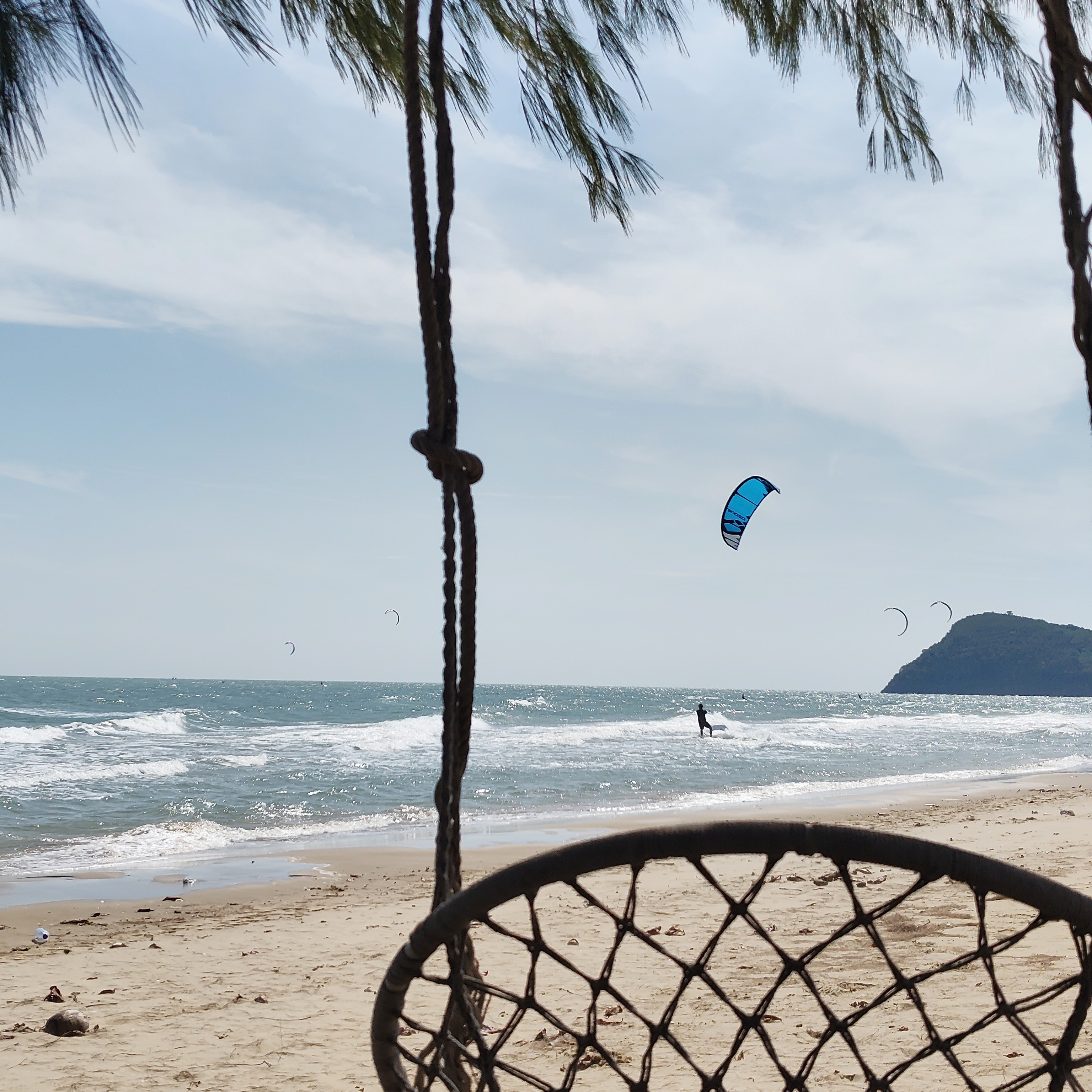
The Gulf is completely flat at dawn. By noon it's flying. By sunset it's flat again. None of this is random.
Most people experience the weather at Pak Nam Pran as a series of pleasant surprises. The beach is wide in the morning and narrow in the afternoon. The wind picks up at noon without warning and dies at sunset on a schedule. The smokey season in Chiang Mai coincides exactly with the best kite conditions here. None of this is random. All of it is physics — and once you understand it, the whole coast starts to make more sense.
Why the Gulf Has Only One Tide Per Day
Most coastlines in the world experience four tides in every 24-hour period — two highs and two lows, roughly six hours apart. The Gulf of Thailand does something different. Here, there is one high tide and one low tide per day. The beach you see at 6am is dramatically different from the beach you see at 6pm, but the cycle takes a full day rather than half a day. This is called a diurnal tidal pattern, and it is rare enough that scientists have devoted considerable research to explaining it.
The simplified explanation goes like this. The moon's gravitational pull creates a tidal bulge that travels around the Earth as the planet rotates. In most open oceans, this produces two bulges and therefore two tidal cycles per day. But the Gulf of Thailand is a semi-enclosed basin — a long, relatively shallow body of water roughly 660 kilometres from head to mouth, with an average depth of only 36 metres and a notable right-angle turn in its middle section. This shape creates a resonance effect.
Think of a bathtub. If you push water back and forth at exactly the right frequency, it sloshes in a consistent, amplified rhythm. The Gulf of Thailand acts similarly — its geometry, depth, and the influence of the South China Sea at its opening create a resonance that strongly favours one tidal cycle per day. The semi-diurnal (twice-daily) wave that tries to enter from the south gets cancelled out as the outgoing tide meets the incoming one in the middle of the Gulf. They clash and neutralise each other. What's left is a single daily oscillation.
The Gulf is a semi-enclosed basin 660 kilometres long and 36 metres deep on average. Its shape creates a resonance that produces one tide per day instead of two. The science is more complicated than the bathtub analogy — but the bathtub analogy is correct enough.
This has practical consequences that most visitors to the Gulf coast never understand until they experience them directly. During the high-tide months — roughly November through March — the water is high during the day and low at night. The beach may narrow to a thin strip in the afternoon. During the low-tide months — roughly May through September — the water pulls back during the day, exposing wide sandbars and shallow flats that extend far from shore.
At Pak Nam Pran, the transition is noticeable but not extreme. The tidal range here is modest — around one to two metres — compared to some Gulf locations further north where beaches can disappear entirely at high tide. But the difference between low and high tide is enough to transform the beach width, change the kite conditions, and determine whether the hidden beach at Khao Kalok is accessible or not. Always worth checking before you plan your day.
The Two Wind Seasons
The winds here operate on a completely different clock from the tides, driven not by the moon but by the differential heating of land and sea across Southeast Asia. There are two distinct seasons, and they produce two completely different experiences on the same beach.
Season One: The Northeast Monsoon (October to January)
In October, the massive landmass of continental Asia begins to cool as winter approaches. Cold, dense air builds over the interior of China and Southeast Asia and flows outward — south and southeast — toward the warmer sea. This is the northeast monsoon, and it reaches Pak Nam Pran as a consistent wind from the northeast, typically 15–25 knots during peak months of December and January.
The NE monsoon wind is strong and reliable but arrives primarily in the mornings, tapering off by mid-afternoon. At its peak it raises chop on the Gulf — not large waves, but enough to give experienced riders something to work with. The air is drier and cooler than at other times of year, temperatures dropping to 24–26°C on windy days. The sky is typically clear. The mornings are the time to be on the water; afternoons are for everything else.
This is also the high-tide season. The beach is at its narrowest in the afternoons. For kiting this means timing matters — get out early, read the tide, pick your spot accordingly.
Season Two: The South Wind / Thermal Season (February to May)
This is the season I came here for. The season most serious riders consider the better one.
From February onward, the northeast monsoon weakens and a thermal pattern takes over. As the sun climbs higher and the land heats up through the morning, a pressure differential builds between the warm land and the cooler Gulf. Air flows from sea to land — from the south — in what's called a sea breeze or thermal wind. It builds slowly through the morning, hits its stride around noon, and blows consistently through the afternoon until sunset.
This is the wind that makes Pak Nam Pran exceptional. South thermal winds are smoother, more consistent, and less gusty than the NE monsoon. The water is flatter — the wind is coming from the south and the fetch is shorter on this part of the coast, so the sea stays manageable. Afternoons are the prime time, which inverts the NE monsoon schedule entirely.
March and April are the peak. This is also when Chiang Mai fills with smoke from agricultural burning in the north — the thermal inversion traps the haze in the valleys. The combination is not a coincidence. The same atmospheric conditions that cause the smoke in the north drive the wind in the south. When the air quality app turns red in Chiang Mai, the wind forecast for Pak Nam Pran turns green. I have planned multiple trips around exactly this pattern.
When the air quality app turns red in Chiang Mai, the wind forecast for Pak Nam Pran turns green. The same atmospheric pattern that causes the smoke drives the wind. I have planned multiple trips around exactly this.
The Off-Season (June to September)
The southwest monsoon arrives from the Indian Ocean, crosses the Malay Peninsula, and reaches the Gulf coast as a wind that is largely offshore — blowing from land to sea — which makes it unsuitable for kiting and brings rain. This is the quiet season. The beach empties, the kite schools reduce operations, and the coast reverts to something close to its default state: fishing village, flat water, locals.
The tides during this period shift to the low-tide pattern — water pulls back during the day, exposing the sandflats. It's not a bad time to visit for other reasons. The crowds are gone, prices drop, and the landscape turns greener than at any other time of year.
Why Pak Nam Pran Specifically
Hua Hin, thirty kilometres north, receives the same monsoon winds. But Pak Nam Pran consistently records 1–3 knots more wind than Hua Hin, and the wind quality is better — cleaner, less gusty, more predictable. The reason is simple geography. Hua Hin is a town with hotels and buildings that interrupt and turbulate the airflow. Pak Nam Pran is an open beach backed by low land, with no obstructions. The wind arrives from the northeast or south, hits the open coastline cleanly, and delivers exactly what the forecast says.
The Asian Kiteboarding Championships are held here. That is not a coincidence either.
Reading the Beach
Once you understand the two systems — tidal and wind — the beach becomes readable. Low tide plus NE wind in the morning: wide sand, choppy water, get out early. High tide plus south thermal in the afternoon: narrower beach, flat water, ideal conditions for all levels. The combination that draws serious riders from across Southeast Asia every March is exactly this: spring thermal winds, relatively low tide exposing flat sandbars, warm clear water, and a beach that hasn't been overbuilt yet.
It's a specific set of conditions that won't last forever once the coast becomes more developed. For now, it's here. And if you own property on this beach, you wake up to it every day it occurs.