Pranburi Travel Guide 2026
Beaches, Nature & Why Own a Villa Here
Pranburi is everything Hua Hin used to be — quiet, unspoiled, and genuinely Thai. Here's why discerning buyers are looking at Pak Nam Pran instead.
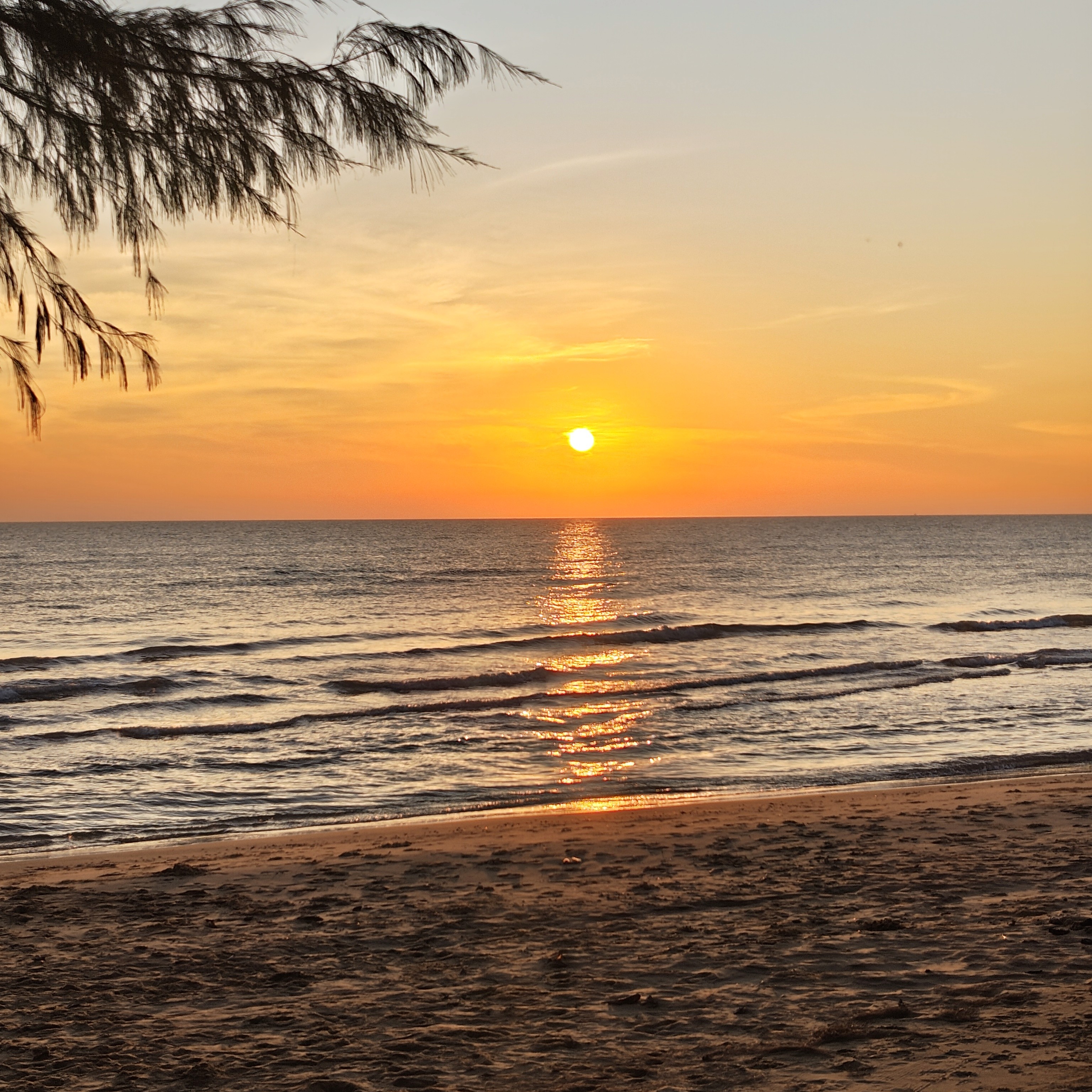
Pak Nam Pran Beach at sunrise
It's 5am and I'm on a bicycle heading south in the dark.
Why This Coast Is Different
I'll be honest about how I first came here — it was the kite surfing. My friend Mitja and I drove down from Chiang Mai during the smokey season — that stretch of March and April when the north fills with haze and the air quality makes you want to be somewhere else entirely. Pranburi is the obvious answer. Clean air, flat water, and the best kite wind in Thailand.
Pak Nam Pran is the only real kite surfing destination in the country worth talking about. Before this I was kiting every day in Xiamen, China — better winds there, honestly, the kind of consistent offshore that spoils you — but nothing in Thailand comes close to what this stretch of the Gulf does during the smokey season. The wind comes in strong and reliable, day after day, and the water in front of the beach is perfect for it. The Asian championships are held here for exactly that reason.
If you kite, you already know this. If you don't, it explains why you'll see serious riders launching in conditions that would be considered exceptional anywhere else in the country. Mitja and I came for a long weekend and stayed considerably longer than planned.
There's a tendency to describe Pranburi as "Hua Hin but quieter." That's accurate as far as it goes, but it undersells what this place actually is. Hua Hin is a resort town — excellent infrastructure, good restaurants, the comforting familiarity of somewhere that has been catering to visitors for a century. But you are also, in Hua Hin, sitting behind a monstrous wall of hotel complexes. The beach exists somewhere behind the towers, accessed through lobbies and pool decks and the general machinery of mass tourism. Pak Nam Pran is not like that. You are on the beach. Directly on it. Pine trees, sand, Gulf water — no intermediary architecture between you and the reason you came.
The people who understood this earliest built accordingly. Ichi Ton — the Thai tea drink mogul — owns Villa Maroc, a hotel right on the beach here. Casablanca-inspired, whitewashed walls, archways, the Gulf as a permanent backdrop. Stunning. Genuinely one of the most beautiful properties on this coast. I will say — as someone who has now spent a serious amount of time thinking about what makes a place actually liveable — that some of the design choices around privacy suggest that whoever made the bathroom decisions had perhaps never actually stayed anywhere. But the instinct to be here, on this beach, building something worth looking at — that instinct was exactly right.
The beach at Pak Nam Pran runs for several kilometres in a gentle arc, pine trees shading the upper shore, the sand pale and fine, the Gulf doing almost nothing most mornings. Kite surfers own the afternoon — mid-March conditions are exceptional, serious riders working the wind above water that was completely flat at dawn. The sunrises here are the kind you stop everything for. Warm orange on a flat sea, fishing boats already out on the horizon, and sometimes — at the right time of year — a crescent moon still visible above the waterline as the sun comes up behind it.
Thailand's poet Naowarat Phongpaiboon — National Artist, the man who spent years travelling every province recording the beauty of Thai landscapes in verse — wrote about this Gulf coast in his celebrated collection Khian Phaendin, "Writing the Land." Coming here, you understand why.
This particular quality of light, this specific meeting of limestone and sea and flat water, is unlike anywhere else in the country.
Best time: November through March for calm seas and reliable sunrises. March and April bring the best kite winds — the whole reason serious riders come here.
The 5am Bike Ride
This one requires some willpower but pays back immediately. Get on a bike at around 5am and ride south along the coast road towards Khao Sam Roi Yot National Park.
The landscape at that hour is something else entirely. The light is still low and blue, the road is completely empty, and as you get further from the village the karst mountains start appearing out of the morning haze — enormous limestone formations rising straight out of flat land, wetlands on one side, the Gulf on the other. It's the kind of scenery that stops making sense in the best possible way. You find yourself wondering if you've accidentally cycled into a painting.
By the time you reach the park boundary the sun is coming up properly and everything turns gold. Turn around there or push further in — either way the ride back with the light behind you is a different experience again. You'll be back for breakfast before most people have opened their curtains.
Bikes are easy to hire locally. Go early, bring water, and don't tell anyone how good it was or they'll all start doing it.
Khao Kalok — The Mountain With the Impossible Trees
The limestone headland at the south end of Pak Nam Pran beach is called Khao Kalok. You can climb it. Start early, because it gets hot faster than you expect and the ropes section in the middle is real work. There are caves along the way that reward a moment of exploration, and the trees up here are extraordinary — ancient, twisted things, their trunks erupting with what look like cactus.
When my kids were small I told them these were the famous Tractus trees. The only ones in the world. They believed me for an embarrassingly long time. I have no idea what they're actually called. I still think Tractus is better.
From the top, the reward is the full sweep of Pak Nam Pran beach behind you, the open Gulf ahead, and to the south the peaks of Khao Sam Roi Yot materialising through the haze. At low tide, a hidden beach becomes accessible around the far side of the headland. Getting there involves some scrambling. It's worth it for the same reason all slightly difficult things are worth it: because nobody else is there.
At the base of the mountain, a small seafood market runs from early morning. The fishermen bring in whatever came up overnight, it gets cooked at plastic tables set in the sand, and you eat it while the light is still low and golden. It costs almost nothing and is the best meal of the week.
Im Jai Im Ok — Dinner on the Beach
For dinner, Im Jai Im Ok is the place. Big Thai-style shared dinners, tables right on the beach, and the kind of sunset colours that make everyone at the table go quiet for a minute and just look. It's the sort of restaurant that doesn't need a review — you arrive, you order too much, you don't want to leave.
The kind of sunset colours that make everyone at the table go quiet for a minute and just look.
The King Who Came to Watch the Sky
Thirty-five minutes south of Pak Nam Pran, the road ends at the edge of Khao Sam Roi Yot National Park. The vast majority of people staying in Hua Hin, 45 minutes north, have never seen it. But people have been coming here for a long time.
In August 1868, King Mongkut — Rama IV, the mathematician-monk king — brought French astronomers and European diplomats to the marshes at what is now this national park. He had calculated, two years earlier, that a total solar eclipse would occur on 18 August at precisely this point on the Gulf coast. His calculations were accurate to within two seconds — better than the French. They all watched the sun disappear together.
Six weeks later, King Mongkut was dead. Malaria, contracted in those same marshes. His young son stood beside him that August morning — the boy who would become King Chulalongkorn, Rama V. Twenty-two years later, Chulalongkorn returned to this coast and had a royal pavilion built inside Phraya Nakhon Cave: the Kuha Karuhas Pavilion. Red and gold, sitting on the cave floor beneath a column of morning light. It's still there.
In May 2020, archaeologists found cave paintings in the Khao Sam Roi Yot area estimated at 3,000 years old — hunting scenes, human figures, an animal that appears to be a serow still found in these hills today. People were reading this landscape three millennia before King Mongkut calculated his eclipse. Whatever draws people to this coast is not a recent discovery.
Getting Here from Bangkok
The drive south on Highway 4 takes 2.5 to 3 hours. Past Hua Hin, another 30 kilometres to Pranburi and then Pak Nam Pran. Leave on a Friday evening and you arrive for a late dinner. The Bangkok–Hua Hin high-speed rail, currently in progress, is expected to cut the journey to under two hours when it opens around 2027.