Khao Sam Roi Yot
The cave with the pavilion, the king's eclipse & a marsh full of lotus
One of Thailand's most iconic caves, a wooden boardwalk through lotus fields, a quiet beach — all 35 minutes from your front door.
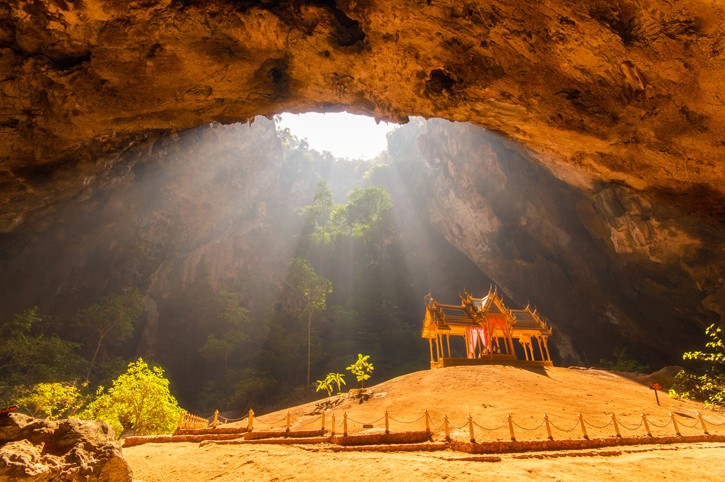
Phraya Nakhon Cave. The pavilion has been catching that light since 1890.
In August 1868, a king brought French astronomers to this coastline to watch the sky go dark.
Thirty-five minutes south of the villa, the road runs out of flat land and the limestone peaks begin. You've been seeing them since the 5am bike ride — shapes on the southern horizon that don't quite make sense until you're standing among them. This is Khao Sam Roi Yot. In Thai, the name means "mountain with three hundred peaks." From inside the park you understand why.
The best day anyone in our household ever had here, I missed entirely. I was in China working. My wife took everyone — the whole household, staff from the office, all the kids — down for Songkran. The caves, the boat, the lotus fields. I got the photos that evening. Everyone was soaked, grinning, and had clearly had a better day than I had.
That's the thing about owning somewhere like this. The place keeps giving even when you're not there.
The Cave — And Why You Go Before 11am
Phraya Nakhon Cave is the reason most people make the drive. It sits inside Khao Sam Roi Yot National Park and requires a short boat ride or a 30-minute hike over a headland to reach Laem Sala Beach, then another 30 to 40 minutes uphill from the beach to the cave entrance. The hike is steep in places. It is hot. It is worth every step.
Inside the cave there are two chambers. The first is dark, rocky, dramatic in the way caves are when the scale is bigger than you expected. The second is the one people come for.
The roof of the second chamber has collapsed — not recently, but long enough ago that a forest has grown inside. Trees, ferns, shafts of light cutting through the opening and hitting the cave floor at an angle that changes with the hour. In the centre of this chamber stands the Kuha Karuhas Pavilion — red and gold, built in 1890 for King Rama V. The signatures of Rama V and Rama VII are still on the cave walls.
The light column hits the pavilion directly between roughly 10am and 11.30am. Arrive before 10 and you wait in a cave that is already extraordinary. At 10 the show begins. People who have seen this consistently describe it as the most beautiful thing they have encountered in Thailand. I am not going to argue with them.
In the centre of the chamber stands the Kuha Karuhas Pavilion — red and gold, built in 1890 for King Rama V. The light column hits it directly between 10am and 11.30am.
The King Who Predicted the Eclipse
The history here goes deeper than the pavilion. In August 1868, King Mongkut — Rama IV, the mathematician-monk king — brought French astronomers and European diplomats to the marshes of what is now this national park. He had calculated, two years in advance, that a total solar eclipse would occur on 18 August at precisely this point on the Gulf coast. His calculations were accurate to within two seconds — better than the French.
They all watched the sun disappear together, standing in these same marshes.
Six weeks later, King Mongkut was dead — malaria contracted in the wetlands that August. His young son Chulalongkorn stood beside him that morning. Twenty-two years later, now King Rama V, Chulalongkorn returned to this coast and had the pavilion built inside the cave. The one that still stands there today, catching the light every morning.
The Lotus Boardwalk
On the other side of the park — same entrance ticket, different road — the Bueng Bua boardwalk stretches for 1.2 kilometres over Thailand's largest freshwater marsh. The Thung Sam Roi Yot wetlands are a Ramsar site, internationally protected. The limestone peaks rise directly behind the water. More than 300 bird species have been recorded here.
Between January and March the lotus flowers are at their peak — the whole marsh goes pink. A boat ride through the canals costs 500 baht for up to four people and takes an hour. Go early. The lotus flowers close by late afternoon, and the birds are most active in the cool of the morning when the light on the mountains is still low and warm.
When my wife brought everyone here during Songkran, the marsh was full. The photos showed purple herons, egrets working the shallows, the kids on the boardwalk pointing at things in the water. The mountains behind them doing what they always do — looking like something from another era entirely.
Between January and March the lotus flowers are at their peak. The whole marsh goes pink. The limestone peaks rise directly behind the water.
Practical Details
The drive from the villa is 35 minutes. Entry to the national park is 200 baht per adult, 100 baht for children — the same ticket covers all sites in the park for the day. For the cave, take the boat from Bang Pu fishing village to Laem Sala Beach (400 baht per boat, 5 minutes) rather than the overland hike — save your legs for the trail up to the cave itself. Closed-toe shoes, a litre of water per person minimum, and arrive at the cave entrance by 9.30am to have it to yourself for a few minutes before the tour groups.
The lotus boardwalk and the cave are on opposite sides of the park. Plan for a full morning, bring lunch money, and leave before the afternoon heat arrives.
From the villa to one of the most historically significant and visually extraordinary places in Thailand — 35 minutes. Most people staying in Hua Hin never make it here. You live next door.